

Jazmine Kendall
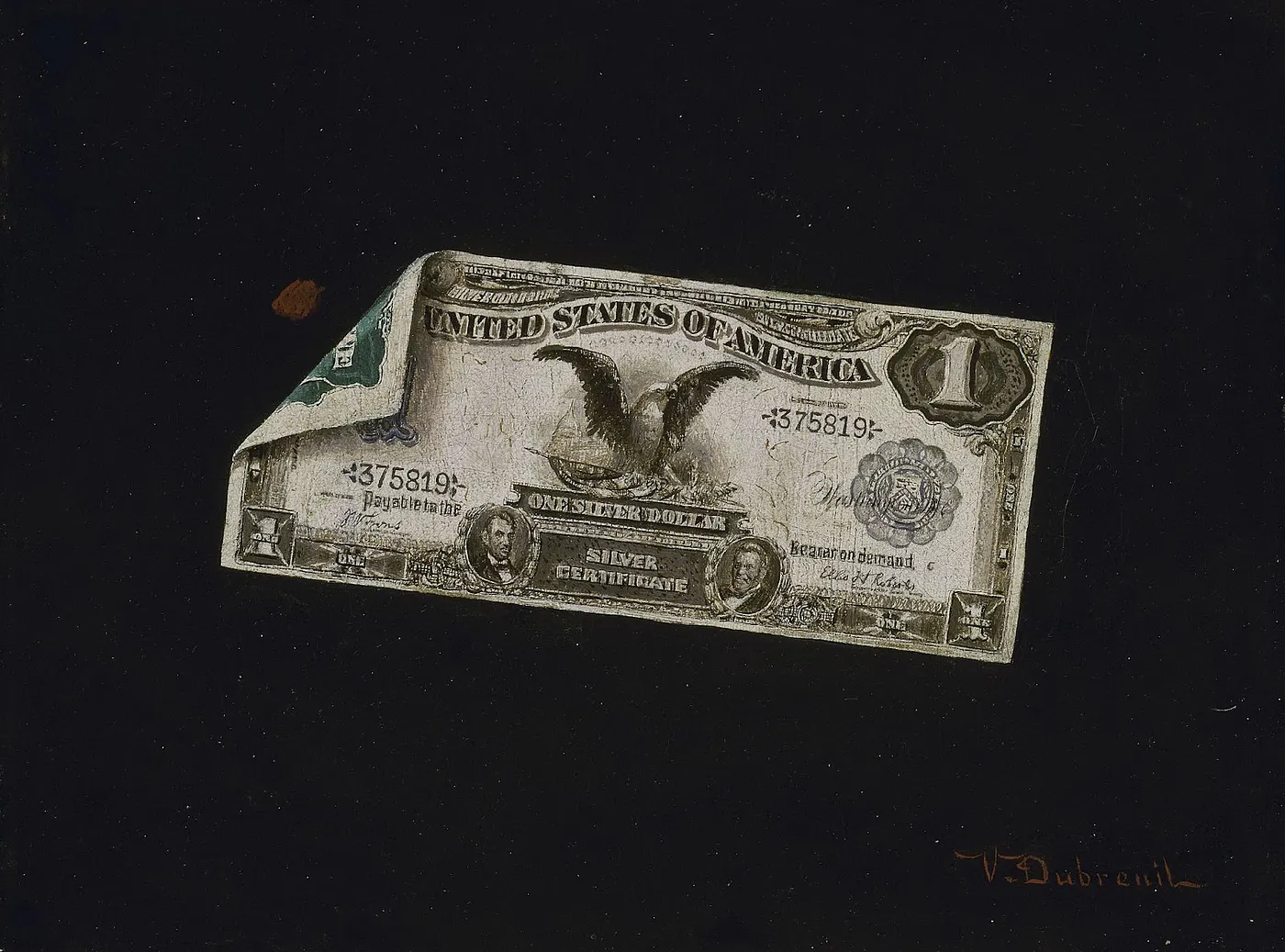
The US dollar remains king, despite vultures circling. (Image credit: The Art Institute of Chicago)
The pillars of the American empire have been a little wobbly recently. Analysts from J.P Morgan, Australian Financial Review, and the World Economic Forum smell blood in the water, musing on the potential demise of the US dollar’s role as the global reserve currency.
As venerable economic historian Adam Tooze reminds us, any prediction about the dollar’s future trajectory is inherently speculative and shaped as much by narrative logic as by hard data. Humans are drawn to coherent stories with clear arcs: beginnings, middles, and ends. We often project this structure onto history, searching for patterns that mirror our myths, beliefs and biases.
The US dollar’s meteoric rise to global reserve currency fits neatly into such a narrative. Since the interwar period, its tendrils have curled around nearly every financial system, commodity trade, and reserve pool on the planet. Given this arc, it seems only natural to anticipate a fall.
The idea of an imminent decline feels especially compelling amid a growing chorus forecasting the collapse of American hegemony, the emergence of a multipolar world, and the rise in alternatives like gold and Bitcoin. But how likely is it that reality will conform to this tidy narrative?

Before we can predict where things are going, we need to understand what sustains the US dollar’s hegemonic position. Carla Norrlof, Professor of Political Science at the University of Toronto, asserts that for a currency to be the global reserve currency, it needs to serve three roles in the global economy:
Right now, the US dollar is the only currency that does all three at a global level. The US worked hard for it to be that way using three different types of power:
Hence, two necessary conditions must be satisfied for the prevailing currency hierarchy to change from the US dollar to another currency:
People tend to focus on the first necessary (but insufficient) condition: Other countries, like China, are catching up to the US in indicators of monetary capability (i.e., GDP output, trade, defense expenditures, capital market and financial openness). This is true, the gap is closing. But, if the US dollar is still the only currency used everywhere — for buying, saving, and pricing — then it doesn’t matter if the US has “some problems”. Dollar hegemony will prevail.
While the United States cannot force other actors to trade in their currency, it has made the US dollar the most widely used and accessible currency in global financial markets. As a result, many governments and businesses use US dollars simply because it is the most convenient option.
Through policies and relaxed regulations, the United States has ensured that its financial and capital markets remain large, open and liquid to provide easy access to investment. It has also encouraged other countries to circulate US dollars domestically. This reduces transaction costs by removing the need for constant currency conversions. Businesses are incentivised to price goods and settle payments in US dollars, as they can recycle dollar revenues within the host economy for future transactions.
American economist Thomas Palley highlights how the United States’ domination of global governance institutions (e.g. , World Bank, IMF, NATO, UN, OECD, WTO, GATT, VIS, OAS) enables the US to shape international rules in ways that serve its own interests. These forums also amplify US norms and expectations, reinforcing dollar usage as both functional and inevitable through default rules, framing effects and institutional path dependence.
In “Underground Empire” (2023), Henry Farrell and Abraham L. Newman argue that the United States has also built a vast informal empire by embedding itself into the infrastructural “plumbing” of global finance, information and trade. Through its control of payment networks, financial standards, and surveillance systems, the US exercises “weaponised interdependence” as an extremely effective form of geopolitical leverage.
In a more recent 2025 analysis, however, the same authors assert that Trump’s second term has eroded this informal empire, persuading “America’s allies to defect from America’s economic networks. Mr Trump’s second term has changed their calculus — now even European allies are quietly talking about moving closer to China. It’s increasingly hard to see the benefits they get from their ties to America, and increasingly easy to see the costs.”
The United States has used a litany of carrots and sticks to ensure that goods and services are priced in US dollars. One gobsmacking example of the deals, military pressure and strategic partnerships that are wielded is the petrodollar system.
After the 1973 oil crisis, the United States struck a strategic deal with Saudi Arabia: in exchange for military protection, arms sales, and political support, Saudi Arabia would recycle billions in oil revenues into U.S. Treasury bonds, helping finance America’s budget deficits.
The petrodollar system entrenched US dollar dominance by recycling oil profits into US treasury bonds and dollar-denominated assets. Oil-exporting countries in the Gulf accumulated vast reserves in dollars, reinforcing the currency’s role as a global store of value and deepening liquidity in US capital markets. The petrodollar’s legacy endures, with most oil still priced and traded in US dollars today.
The United States promotes dollar use by offering safe, profitable investments and by using its political power to shape financial behaviour. To keep the dollar attractive, the US promotes investment in dollar-based assets like US treasury bonds, real estate, and stocks. These have historically offered a mix of safety, profit, and flexibility, making them appealing for foreign governments and private investors. People also trust the dollar because the United States is seen as economically strong, politically stable and capable of maintaining control over inflation and monetary policy because they have a stable system of law.
The United States’ global influence also strengthens international trust in the dollar, particularly through its capacity to exert military and financial pressure. For instance, the US holds a credible threat of freezing foreign government assets in response to actions it deems hostile. This was demonstrated in 2022 when the United States, alongside key allies, froze $280 billion in Russian sovereign assets following Russia’s invasion of Ukraine. However Professor of Sociology at Duke University Gao Bai asserts that this freeze “triggered concerns in many countries about the risk of holding dollar-denominated assets, prompting them to transfer these assets away from developed countries and to actively seek alternatives to the US dollar.”

For another currency to present a formidable challenge to the US dollar hegemony, it would have to replicate similar conditions that currently support widespread dollar use. Right now, no other currency has the full infrastructure in place to offer a truly viable alternative. That said, this space is rapidly changing. There are some noteworthy developments unfolding that are worth a closer look.
China is the world’s largest economy by purchasing power parity terms and second-largest economy when measured by nominal GDP, recording an estimated 5% real GDP growth in 2023–24. In recent years, it has actively used its bargaining, structural, and socialising power to promote global use of the Renminbi.
As Wei (2025) observes, China is constructing with the BRICS alliance a parallel financial system centred around the Renminbi. This includes institutions like the New Development Bank, the Asian Infrastructure Investment Bank, and the Belt and Road Initiative, which spans over 130 countries.
These strategic efforts have propelled Renminbi use as both a medium of exchange and unit of account, particularly through state-led trade, infrastructure deals and global governance institutions. China’s Cross-Border Interbank Payments System facilitates Renminbi-based transactions and endeavours to rival SWIFT. As a store of value, offshore Renminbi bonds surged from USD 12.6 billion in 2022 to USD 151.1 billion in 2023, signalling growing confidence in Renminbi-denominated assets.
However, these advancements are tempered by concerns regarding political interference from Chinese authorities, strict capital controls, and the underdeveloped depth and openness of China’s financial markets. Naef et al. (2022) contend that further liberalisation of China’s capital account is a necessary step for it to rise to become a true global reserve currency. Nonetheless, even without full liberalisation, the Renminbi could still increase its international role through channels such as import financing, debt repayments, payment infrastructure, currency swap agreements and offshore markets.
As the shared currency of the twenty European Union countries, the Euro benefits from being backed by a large and developed economy, stable financial institutions, and a well-regarded central bank. However, the EU’s real GDP growth has slowed quite considerably over recent years, from a hearty 6.3% in 2021 to a meagre 1.1% in 2024.
Within the European Union, the Euro is widely used to buy and sell goods and services, and plays a modest role in international trade beyond the EU, particularly with Africa and parts of Asia. However, its usage in global private transactions remains relatively limited compared to the US dollar.
When used as a unit of account, the Euro is prominent within the EU and is occasionally used in commodity pricing. However, most global trade and commodities, particularly oil, remain priced in US dollars. The EU has made efforts to push for Euro invoicing in trade, but inconsistent coordination among member states has limited effectiveness.
Where the Euro shines is as a store of value. It is widely held by central banks and institutional investors across the world. Its financial markets, especially in Euro-denominated bonds, are well-developed and trusted, although still smaller and less liquid than US Treasury markets. According to a 2025 Financial Times article, for the Euro to become a more prominent reserve currency, the EU would need to issue more AAA-rated euro-denominated assets and overcome political divisions that hinder progress towards deeper financial integration and greater credibility.
In contrast to both the Euro and Renminbi, Bitcoin was not created by any state and operates on an entirely decentralised network. Its appeal lies in the promise of an alternative financial system that is borderless, apolitical, and resistant to government interference and dilution. Bitcoin is accepted as a means of payment by some online businesses and in certain niche markets, but its use as a global medium of exchange is limited by its high price volatility, slow transaction speeds, and technical complexity.
Bitcoin has no central authority to promote its adoption or negotiate with governments. Its development and outreach are entirely reliant on market forces and grassroots enthusiasm driven by its status as the best-performing investment asset of the past decade. The infrastructure around Bitcoin is rapidly improving, but it remains fragmented, energy-intensive and slow compared to traditional financial systems. In addition, its public image is polarising: some see it as revolutionary, while others view it as speculative and risky.
As a unit of account, Bitcoin performs poorly. Its price fluctuations make it nearly impossible to use as a stable reference for pricing goods and services. Unlike the dollar or Euro, it lacks the structural and institutional stability that makes currencies reliable tools for pricing daily transactions.
Bitcoin’s greatest promise lies in its role as a store of value. Its fixed supply and decentralised nature appeal to those wary of central banks and the United States’ ballooning debt-to-GDP ratio. However, it requires broader trust, more sophisticated regulatory infrastructure, greater price stability, and a more mature Layer 2 ecosystem to support efficient transactions if it is to gain more prominence in the global economy.
The tale of the dollar is one of endurance. Though the pillars of American power now bear hairline cracks, the US dollar endures as the undisputed king of global finance, enthroned by deep markets, a historically stable legal system, and decades of entrenched power.
Yet beyond the walls, rival currencies gather. The Renminbi eyes the crown, but China must cast off the shadows that have long cloaked its markets in opacity. The Euro cannot rise while the European Union remains fragmented and hesitant. Bitcoin must prove its mettle through price stability and growth. These changes are not mere reforms — they are upheavals. Without such reckoning, the dollar’s rule may fray but its banner shall fly, for now.
Still, a restless tide swells beneath the surface. The world, once anchored to a single reserve currency, now flirts with pluralism. Whispers of a multipolar world echo louder with each passing year. The dollar’s reign is not yet at its end, but rival currencies gather strength in the shadows, biding their time. The battle for the next heir has begun, and only time will reveal who shall seize the throne.